A big talking point -- and a joke to make in order to discredit the coach -- during the early part of the NBA season has been the game plan from coaches like Byron Scott and Flip Saunders when it comes to 3-point shooting.
The Minnesota Timberwolves coach has been on record saying he wants certain guys not shooting 3-pointers because he wants them to work for a better shot if they don't have the green light on outside shots. It's about learning what a good shot is, which seems like a reasonable strategy as long as you don't completely undervalue outside shooting.
Los Angeles Lakers coach Byron Scott, on the other hand, came off as believing 3-point shooting wasn't a part of a championship game plan, period. Despite the past four NBA champions (2013-14 San Antonio Spurs, 2011-13 Miami Heat, and the 2010-11 Dallas Mavericks) winning titles by utilizing the 3-point shot as well as any postseason team in history, Scott seems to think the 3-point shot is more gimmick than tactic. But in 2014, it's just pretty obvious the 3-point shot has become not only an effective weapon, but the perfect way to counteract the help defense rules originated in 2004 that have caused spacing to be such a valuable component to offense in the NBA.
That doesn't mean everybody should shoot 3-pointers. Not everyone should have the green light to fire away recklessly. You want shots to be created within the flow of an offense and those shots to be as open as possible in order to maximize comfort and repetition of proper shooting mechanics. You basically want to mimic the offensive systems of the Spurs and Mavericks as much as you can because they use spacing and ball movement better than anybody.
However, not all 3-point shots and shooters are created equal in every offensive system.
Heading into this season, the NBA had 18 players in league history take at least four 3-pointers per game while making 30 percent or worse. So far this NBA season, we've seen eight players added to this list (assuming they all play at least 50 games, the cutoff chosen for filtering this list). Some shooters are being asked to take shots they shouldn't take. Some shooters are freelancing and taking shots they shouldn't really be taking. And some shooters could just be working through injuries that have affected their shots.
Let's take a look at the eight players currently shooting 30 percent or worse from 3-point range while taking at least four per game. How many of these players are shooting well below their abilities and which players can maybe start working their way toward that 35.1 percent league average?
Derrick Rose, Chicago Bulls: 30.0 percent from 3, 5.8 attempts per game
 As is the case with many ball dominant (not used as a pejorative) guards, Rose takes the majority of his 3-point attempts from above the break, where the corner 3-point line starts to curve toward the top of the key. There just isn't a lot of action to get Rose or many lead guards 3-point shots in the corner because they spend so much of their time breaking down the defense from straight on.
Back in the 2010-11 MVP season for Rose, he made 33.2 percent of his 3-point attempts. That's a pretty respectable number when you convert that to an effective field goal percentage of 49.8 percent (factors in the extra point for the shot). That's right on the cusp of what you're looking for as a 3-point shooter. Even with league average generally being a couple of percentage points higher, the efficiency of the shot is in the sweet spot of where you want it to be.
The past two games for Rose (combined 3-of-14 from downtown) really brought Rose down to this criteria of 30 percent or worse. And while one quarter of the season is still a small sample size for judging a lot of this stuff, you have to remember it's even smaller for Rose because he's only played in 12 games. For his career, he's only a 31.1 percent 3-point shooter, which is brought down by 1) missing about 2.5 years after he seemingly fixed his jumper quite a bit and 2) his first two seasons in which he couldn't shoot at all. Since his third season, he's made 32.4 percent of his 3's, which still isn't good but more respectable.
Rose has been much more comfortable shooting 3-pointers on pull-ups, rather than catch-and-shoot. He's taking the same number of 3s (2.8 per game) on both types of 3-point shots. On catch-and-shoot attempts, he's shooting 26.5 percent as opposed to 35.3 percent on pull-ups. Give him a lot of room to shoot (six feet or more) and he's knocking them down at a 35.7 percent clip. As that space tightens (31.4 percent on 4-6 feet, 25 percent on 2-4 feet), so does his shooting percentage.
Perhaps, Rose is taking too many 3-pointers at nearly six per game, but he's still working off the rust from time missed. I don't think he'll confuse anybody for Steph Curry any time soon, but he's clearly much more comfortable in rhythm of a pull-up than anything else. Rose should look for better quality shots from downtown, but he doesn't qualify as a guy who shouldn't take them just yet.
O.J. Mayo, Milwaukee Bucks: 29.4 percent from 3, 4 attempts per game
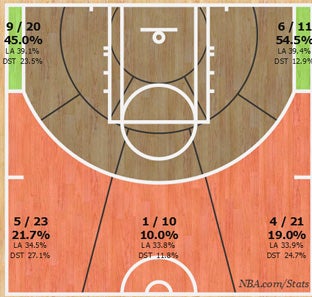 Mayo is a different case. It's not so much the type of 3-point shot Mayo is taking as much as it's about the location of the shot and the defenders surrounding him. As a 37.7 percent 3-point shooter for his career, Mayo certainly has the résumé to keep taking long-range attempts. Mayo has been deadly to opponents from the corners this season, making 48.3 percent of his 3's from the corners.
It's everywhere else that he's a problem. It doesn't matter if he's taking pull-up jumpers to establish a rhythm with the ball (32 percent) or if he's spotting up and shooting off the catch (29.3 percent), Mayo simply can't find a good rhythm anywhere other than the corners. His above-the-break 3-point shooting has been abysmal. He's made just 18.5 percent of those attempts so far this season and they make up two-thirds of his attempts.
Perhaps the solution to get a traditionally good outside shooter like Mayo going is by playing him with Brandon Knight and Jerryd Bayless as much as possible. Give them the ball-handling duties on the court and try to find spacing on the floor with Mayo in the corner. He's too good of a shooter to have fallen off this dramatically.
Kobe Bryant, Los Angeles Lakers: 28.4 percent from 3, 5.3 attempts per game
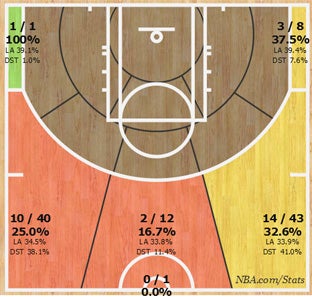 How do you tell Kobe Bryant not to shoot? And is it even a good idea? Shooting 3s never has been a particularly strong part of Kobe's game but he used to be much better than this. From 2002-2009, Bryant was a very respectable shooter from downtown. For a seven-season stretch, Bryant knocked down 35.1 percent of his 3-point attempts while taking 4.8 attempts per game. You'd love for a scorer of Bryant's capabilities to be able to knock down 3s like that.
In the roughly six seasons since that stretch, Bryant has been a really bad 3-point shooter and there's not much you could do to dress it up. That percentage has dropped to 31.6 percent from 3-point range while attempting 4.6 per contest. He's still taking the same number of 3's while making a considerably lower percentage.
Much like Rose, he's a ball-dominant guard and that means he's taking a lot of long-range, above-the-break 3-point attempts. When Scott didn't want his team taking 3's, that message should have gone more toward Kobe. He's taking nearly 30 percent of his team's 3-point attempts. The distribution of Kobe's 3-point attempts on catch-and-shoot (2.4 attempts, 29.2 percent) and pull-up (2.6 attempts, 25.0 percent) is pretty even and it's bad no matter what.
On wide-open shots (six feet of room or more), he's only making 28.3 percent. With 4-6 feet of room, that number goes up to 36.1 percent, which would be great for him. Any closer than that and you're looking at about a quarter of his attempts going in. You can't tell Kobe to not take 3s because his aggressiveness and confidence is what fuels his scoring ability. Also, this Lakers team probably doesn't want to win anyway as they protect their top 5 protected pick owed to Phoenix.
His effective field goal percentage on 3-point shots (42.8 percent) is slightly higher than his field goal percentage on 2-point shots (42.4 percent), so it's statistically just as good of a shot for Bryant as anything else he's taking. But he's more likely to draw fouls and protect his field goal percentage by staying inside the arc.
Kemba Walker, Charlotte Hornets: 26.8 percent from 3, 4.1 attempts per game
 The case of Kemba Walker and shot-making this season are pretty bizarre. He's never been a good player at making shots in the NBA, although he's reliable in clutch situations. But his career field goal percentage is currently less than 40 percent and his career 3-point percentage is a paltry 31.1 percent. Neither is acceptable.
This season, we've seen a huge dip in what Kemba is able to do. You can chalk it up to not feeling comfortable playing alongside Lance Stephenson right now or find another reason, but Walker simply can't hit shots right now. He's had five games in which he shot 40 percent or higher. He's had eight games out of 20 in which he's made a third of his 3's or better.
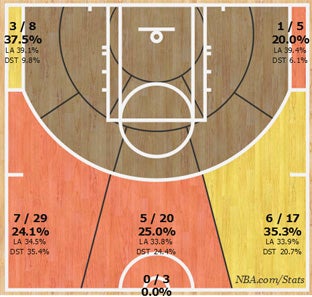
On the season, Walker is shooting just 26.8 percent from 3-point range and there isn't really an area of the floor in which you feel comfortable with him taking a shot. The right wing for Kemba is a 35.3 percent success rate, but do you still feel comfortable with him taking jumpers? I'm not even sure it depends on what type of 3-point shot it is.
Walker has made 33.3 percent of his catch-and-shoot shots, which is right on the cusp of efficient at 50 percent for eFG. His pull-up 3s are going in at a rate of only 14.3 percent. Give him a wide-open 3-point shot and he's knocking them down at a 43.8 percent rate. That's phenomenal, but it doesn't even account for one attempt per game with him. He's 25.7 percent with 4-6 feet of room and 22.7 percent or worse as the space goes away.
I'd be shocked if Walker is this bad all season long, just because even as a poor shot-maker, it still seems inconceivable that he could remain this poor of a 3-point shooter. But they clearly need to space the floor for him and hope he finds his rhythm.
Tony Wroten, Philadelphia 76ers: 26.6 percent from 3, 4.3 attempts per game
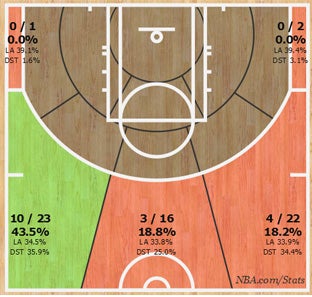 I'm not all that shocked to see Wroten on this list for a couple of reasons. First, he's a career 22.8 percent 3-point shooter and him shooting 26.6 percent from beyond the arc is actually a career-high for him. I guess it's surprising he's allowed to more tha four attempts per game, but when you look at the Sixers' plan for the season it does actually make sense. Second, last season I saw him hit the side of the backboard on a 3-point attempt from the left wing. Not the corner. It was from the left wing and he hit the side of the backboard. That sort of thing stays with you.
Ironically, that left wing has been the sweet spot for Wroten's outside shooting this season. He's made 43.5 percent of his attempts from the left wing and he's under 19 percent from everywhere else around the arc. Much like we discussed with Rose and Bryant, he's a lead guard that has the ball in his hands quite a bit, even with Michael Carter-Williams back from injury. That means you're not going to have Wroten taking 3's from the corners, but even if you did I'm not sure it would help all that much. He's just 3 of 24 (12.5 percent) from the corners for his career.
The only thing that could save Wroten from this list is having a healthy MCW and Alexey Shved the rest of the season. That could cause his attempts to drop below 4.0 per game and then he wouldn't qualify for this list anymore. But I'll guess Sam Hinkie has no problems with Wroten trying to build confidence and rhythm while the Sixers collect ping pong balls for the lottery.
One last interesting note: when Wroten has the ball for six seconds or more, he's a 33.3 percent 3-point shooter. I'm guessing the majority of that happens from that left wing.
Reggie Jackson, Oklahoma City Thunder: 25.4 percent from 3, 4.4 attempts per game
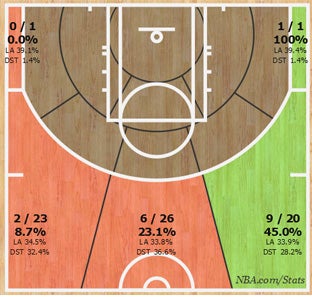 You started to get excited that Reggie Jackson was coming along as a 3-point shooter last season. In his first two seasons of play, Jackson made just 22.2 percent of his 3-point attempts and it didn't look like it would ever be a part of his game. His rate of accuracy from downtown improved to 33.9 percent last season as he embraced the role of Sixth Man and filled in for Russell Westbrook at various times due to injury. That 3-point percentage hasn't held up at all through the first quarter of this season, as he's back down to hitting about a quarter of his 3-point attempts.
Looking at his chart, he's more comfortable -- or at least accurate -- shooting from the right side of the floor. He's made nearly 50 percent of those 3s. Anywhere from the middle to the left and you're looking at an apocalyptic percentage of 16 percent. The tricky thing with Jackson so far this season is I'm not sure you can take too much away from his play so far. He was asked to be "The Guy" with Kevin Durant and Russell Westbrook missing the first month of the season, and all of the defensive pressure moved toward him.
With Durant and Westbrook back on the floor, Jackson's role should get a lot easier as he becomes a complementary player and not the leader. Perhaps we'll see his percentage rise back to the near league average accuracy we saw last season with him. But even then, he's made just 15.6 percent of his catch-and-shoot 3s and is a 33.3 percent shooter on pull-ups. It hasn't mattered how open he is this season, either. He's a 26.1 percent shooter or worse from all of the areas of shot contest tracked here.
Although much like Wroten, Jackson has been a better shooter from deep when he's had the ball for six seconds or more. He's making 41.7 percent of those shots. Get out of the way, Russ and KD.
Nicolas Batum, Portland Trail Blazers: 22.7 percent from 3, 4.4 attempts per game
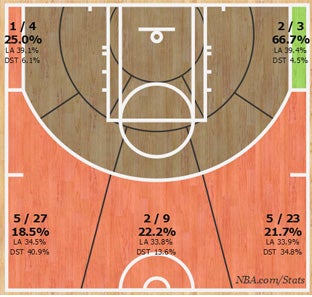 I'll come out and say right away here that I think Nicolas Batum's struggles from 3-point range have been strictly because of injury. He's had a shoulder injury in the past and this season he's been battling a knee injury that kept him out for a few games. It really looks like it's affected his play on the court and his shooting especially. Heading into this season, Batum was a 36.9 percent shooter from downtown and had never shot worse than 34.5 percent in a season. The 22.7 percent from him is startling and he's made just 13.5 percent of his 3s since returning from four missed games.
Prior to the injury, Batum was shooting 34.4 percent from 3-point range and looking much more respectable as a threat from that distance. The question isn't so much whether or not he can shoot as it is whether or not his body will allow him to shoot with accuracy. Knee injuries can throw everything off for a player, especially a jump shot that requires lift, muscle memory, and precision. Batum doesn't have that right now and it's shown since his return.
He's almost exclusively a catch-and-shoot guy from beyond the arc (40.3 percent of his total shots are catch-and-shoot 3's) and when given a wide-open attempt, he's making 36.1 percent. The Blazers just need his knee to heal and his body to readjust so he can go back to being the floor-spacer we've seen so often from him.
C.J. Miles, Indiana Pacers: 19.6 percent from 3, 4.3 attempts per game
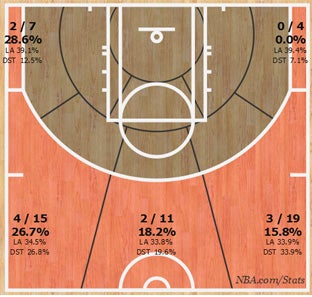 C.J. Miles has been all over the place as a 3-point shooter in his career. It was a roller coaster for him when he was with the Utah Jazz. He went from a non-threat his first two seasons (23 percent) to a deadly 3-point shooter his third season (39 percent). He then saw his percentage decline for four straight seasons as he finished out his time with the Jazz in 2011-12 as a 30.7 percent shooter from 3. Then Miles went to Cleveland where he rediscovered his shooting stroke.
In two seasons with the Cavaliers, Miles made 38.8 percent of his 3-point attempts and attempted 539 of them in 116 games. It may have been a win-win situation with Miles in Cleveland because the team was horrendous and he had zero pressure to perform, outside of making a name for himself as a shooter for future free agency suitors.
That shooting was one of the main reasons the Indiana Pacers added him this offseason, committing about $18 million over four years to Miles. So far, he's been a dud with his 3-point accuracy. He's making just 19.3 percent of his 3's this season but he keeps taking them at a pretty decent rate. He's had two injuries that have been debilitating for him so far. He's battled migraines and a calf injury and it's cost him time and comfort on the court.
Perhaps as he gets healthier, he'll be able to find that stroke from Cleveland. The Pacers need as much outside shooting as they can get without Paul George this season. They're just 27th in the NBA in 3-point percentage and Miles' shooting coming to life would be a big boost.