
Agent's Take: From Patrick Mahomes' recovery, to Travis Kelce's potential retirement, Chiefs' future uncertain
The Chiefs are in an unfamiliar spot after missing the playoffs for the first time since 2014
By
Joel Corry
•
9 min read
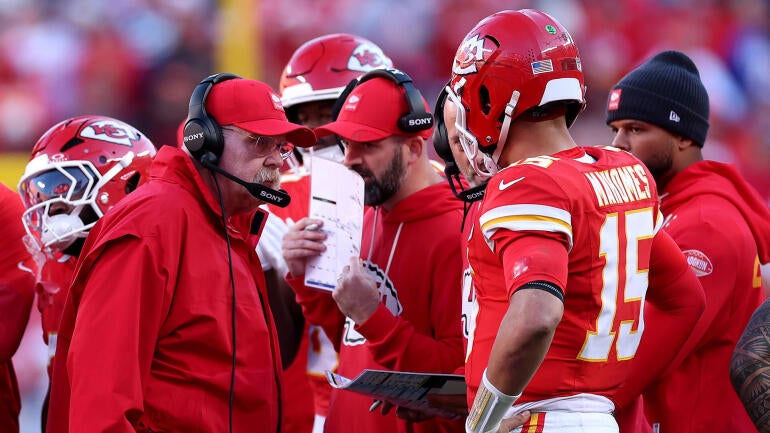
The idiom, "All good things must come to an end" is applicable to the 2025 Kansas City Chiefs. For the first time since quarterback Patrick Mahomes became a starter in 2018, the road to the Super Bowl doesn't go through the Chiefs in the AFC. A stranglehold on the AFC West is over after nine straight division titles. Not only is Kansas City missing the playoffs but is assured of the first losing season during Andy Reid's 13-year tenure as Chiefs coach. With a 6-9 record, a top 10 pick in the 2026 NFL Draft is a distinct possibility.
Here's a look at what lies ahead for the Chiefs.
Travis Kelce's potential retirement
Travis Kelce is a first ballot Hall of Famer when the five-year waiting period is over once he hangs up his cleats. The 36-year-old contemplated retirement after the 2024 season. His return was motivated by trying to avenge a lopsided loss to the Philadelphia Eagles in Super Bowl LIX.
Although Kelce is clearly on the decline, he still ranks among the top 10 for tight ends in receptions (seventh), receiving yards (third) and touchdown catches (tied for 10th) this season. Kelce's 68 catches for 803 yards with five touchdowns in 15 games would be a career year for a lot of tight ends. He was just named to the Pro Bowl for the 11th straight time.
Kelce intends on disclosing his plans to the Chiefs by early March, which is before 2026 free agency begins. The two-year, $34.25 million contract, averaging $17.125 million per year, Kelce signed in 2024 expires at the end of the league year on March 11. Kelce playing a 14th NFL season in 2026 would be a surprise.
Patrick Mahomes' recovery
Mahomes, who has been the gold standard for quarterbacks over the last few seasons, tore the ACL and LCL in his left knee late in the fourth quarter of Week 15's contest against the Los Angeles Chargers. If Mahomes' recovery goes according to plan, he should be ready for the start of the 2026 regular season. Adrian Peterson tore the ACL and MCL in his left knee on Christmas Eve during Week 16 of the 2011 season. He didn't miss any games in 2012. In fact, Peterson had a career year. He finished nine yards short of breaking Eric Dickerson's single-season rushing record of 2,105 yards.
There isn't any reason to think that Mahomes won't continue to be an elite quarterback once he is healthy. Joe Burrow tore the ACL, MCL, PCL and meniscus in his left knee 10 games into his rookie season with the Cincinnati Bengals in 2020. He led the Bengals to the Super Bowl the following season.
Salary cap
The Chiefs have one of the NFL's most daunting salary cap situations for 2026. There are $346.507 million of 2026 cap commitments with 41 players under contract, according to NFLPA data. That's the NFL's third most 2026 cap obligations behind only the Dallas Cowboys and Minnesota Vikings. Kansas City has a league-low $148,405 of existing 2025 cap space that can be carried over to the 2026 league year, which also begins on March 11. Under offseason accounting rules, only the top 51 salaries (i.e.; cap numbers) matter.
The 2025 salary cap is $279.2 million, which is a 9.32% increase from 2024. Similar growth would put the 2026 salary cap in the $300 million to $305 million range. The Chiefs should have approximately $357.5 million of 2026 cap commitments with the full complement of players.
Mahomes has the NFL's second largest 2026 cap number at $78,213,888. The $56.75 million he is scheduled to make for 2026 is most for any player next year.
Mahomes' cap figure is untenable with an overage that could be upward to $60 million depending where the 2026 salary cap sets. A contract restructure like this year's in which Mahomes' entire 2025 compensation minus his league-minimum salary and workout bonus were converted into signing bonus would create $43.56 million of cap room.
Defensive tackle Chris Jones' $44.85 million cap hit is the league's second most for a non-quarterback and tops for a defensive player. Ideally, this number will be kept intact considering Jones will be 32 next season and his salary guarantees run out after 2026. Jones has rebounded from a slow start to play close to his usual All-Pro level recently.
The most likely result is some sort of salary conversion will take place with Jones. The $35.1 million Jones is making in 2026 consists of a $19 million base salary, $16 million third day of the 2026 league year roster bonus due on March 13 and a $100,000 workout bonus.
Just Jones' $15 million March roster bonus was converted to signing bonus this year. The Chiefs would pick up $10,666,666 of 2026 cap space by repeating the same with Jones' 2026 roster bonus. Adding dummy or voiding years in salary conversions is something the Chiefs largely refrain from doing. Jones' contract expires after the 2028 season.
Offensive guard Trey Smith is another prime restructure candidate. He has a $24.25 million 2026 cap number with a $20 million salary. Lowering Smith's $19.75 million base salary to his $1.215 million league-minimum salary will create $12,356,666 of 2026 cap space considering he is under contract through the 2028 season.
Right tackle Jawaan Taylor hasn't come close to living up to the four-year, $80 million contract he was given in 2023 free agency. Removing his $27,396,668 cap number from Kansas City's financial equation will free up $20 million of cap room. Jaylon Moore, who is the NFL's most expensive swing tackle with the two-year, $30 million contract, averaging $15 million per year, he signed as an unrestricted free agent in March, could take Taylor's place on the right side of the offensive line.
Cornerback Kristian Fulton is another likely cap casualty. He has been a disappointment after joining the Chiefs in March on a two-year, $20 million deal. Fulton is making $10 million, of which $5 million is fully guaranteed, on a $13 million cap number in 2026. The Chiefs would pick up $5 million of cap space by releasing Fulton, who has been a healthy scratch for a majority of the season.
Free agency
The Chiefs have 22 other unrestricted free agents besides Kelce, including linebacker Leo Chenal, safety Bryan Cook, running back Kareem Hunt, edge rusher Charles Omenihu, running back Isiah Pacheco and cornerback Jaylen Watson.
Assuming Kelce reitres as expected, the Chiefs don't have his obvious successor on the roster. Potential replacements in free agency include Isaiah Likely, David Njoku and Kyle Pitts. Likely's days with the Baltimore Ravens are probably coming to a close after Mark Andrews recently signed a three-year, $39.267 million contract extension, averaging $13.089 million per year. The presumption was Likely, not Andrews, would be the recipient of a contract extension in Baltimore given the former is an ascending 25-year-old player who is nearly five years younger than the latter. Likely's asking price was surely higher than the deal Andrews signed.
Njoku's preference is to play his entire career with the Cleveland Browns. He may be expendable in Cleveland with 2026 third-round pick Harold Fannin Jr.'s emergence at tight end. Fannin's 70 catches, which are tied for fifth among tight ends, are a Browns single-season rookie receptions record. The Andrews deal might be a good barometer for Njoku considering he is in the final year of a four-year, $54.75 million contract, averaging $13,687,500 per year, he signed in 2022 as a franchise player. Njoku, who turns 30 in July, is one of the NFL's better tight ends at picking up yards after the catch.
Pitts is having his best season since he had 1,026 receiving yards as a rookie in 2021 and was selected to the Pro Bowl. The Falcons placing a franchise tag on the 25-year-old isn't out of the question. If Pitts hits the open market, a long-term deal should be less than the $17.125 million per year Kelce has been making.
The running game needs an upgrade. Hunt and Pacheco are collectively averaging 3.8 yards per carry. The last time the Chiefs had a 1,000-yard rusher was in 2017 when Hunt led the NFL with 1,327 yards.
The Chiefs reportedly tried to acquire Breece Hall, who has an expiring contract, from the New York Jets at the Nov. 4 trade deadline. Hall, who has dual-threat capabilities, is on the verge of his first 1,000 rushing yard season.
The 2022 second-round pick likely will be looking to get in the same salary stratosphere as James Cook and Kyren Williams, fellow running backs from the 2022 draft, in free agency. Williams signed a three-year, $33 million extension, averaging $11 million per year, with the Los Angeles Rams during the preseason. Cook's four-year, $46 million extension, averaging $11.5 million per year (worth up to $48 million with salary escalators), from the Buffalo Bills came several days after Williams' deal.
Backup quarterback as an insurance policy could take on additional importance because of Mahomes' injury. Besides current Chiefs backup Gardner Minshew, Joe Flacco (Bengals), Marcus Mariota (Washington Commanders), Kenny Pickett (Las Vegas Raiders), Tyrod Taylor (Jets) and Carson Wentz (Vikings), who was Mahomes' backup in 2024, are the best of the bunch.
The Chiefs made a nominal investment in Minshew signing him to a one-year, $1.17 million deal worth up to $8 million through incentives in March. The base value that the majority of these other backups have played under this season is between $4.25 million and $8 million.
The Chiefs have a history of letting cornerbacks walk in free agency. Kendall Fuller and Charvarius Ward departed for the Washington Commanders and San Francisco 49ers, respectively, as free agents in 2020 and 2022. L'Jarius Sneed went to the Tennessee Titans in 2024 via trade after being designated as a franchise player.
Watson's fate in Kansas City may be intertwined with fellow cornerback Trent McDuffie, who was a 2022 first-round pick. The Chiefs extended the contract of their other 2022 first-round pick, edge rusher George Karlaftis, in July while McDuffie continued to play on his rookie deal.
McDuffie, who is scheduled to play 2026 under a $13.632 million fifth-year option, will likely want top of the cornerback market money similar to Sauce Gardner and Derek Stingley Jr. Gardner is the NFL's highest-paid cornerback at $30.1 million per year. He received a four-year, $120.4 million extension with $85,653,473 of guarantees where $45,153,473 was fully guaranteed at signing from the Jets in July before being dealt to the Colts at the trade deadline.
Stingley became the NFL's first $30 million defensive back in March. The Houston Texans signed Stingley to a three-year, $90 million extension with $89,026,026 in guarantees, of which $48,026,026 was fully guaranteed at signing.
It may make sense for the Chiefs to quickly trade McDuffie with an unwillingness to get in this salary territory. The Chiefs would be hard-pressed to get a comparable return as the Jets received from the Indianapolis Colts for Gardner. Part of the reason the Jets were able to get two first-round picks and a player (wide receiver Adonai Mitchell) was because he had already signed an extension. The Colts have Gardner for the next five years (through the 2030 season) for just under $131 million.
The team acquiring McDuffie would be giving up significant draft capital in addition to signing him long term. Nonetheless, the Chiefs should be able to get a first-round pick and other considerations for McDuffie. It could cost the Chiefs half as much per year to retain Watson instead. The chances of both cornerbacks being on the Chiefs in 2026 are remote.
Outlook
The Chiefs are at a crossroads. There will be stiff competition for supremacy in the AFC West from the Denver Broncos and the Chargers on a go-forward basis. Both teams have a young nucleus. Mahomes' abilities should allow the Chiefs to remain competitive though.
The New England Patriots are also going to be an obstacle to returning to the Super Bowl. Under new coach Mike Vrabel, the Patriots have rebounded from three straight losing seasons to make the playoffs. Quarterback Drake Maye, who was 2024's third overall pick, is an MVP candidate this season. He is just scratching the surface of his talent.