After another humbling College Football Playoff showing, the SEC no longer deserves the benefit of the doubt
With every SEC team watching the CFP title game from home for the third straight year, it's time to reexamine the conference's place in the college football hierarchy

By
Tom Fornelli
•
6 min read
The SEC no longer deserves the benefit of the doubt. That much should be clear to everybody by now.
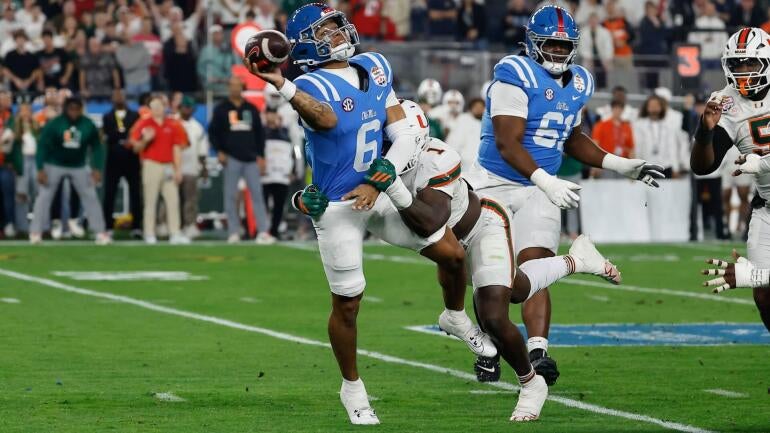
Ole Miss' 31-27 loss to Miami in the Fiesta Bowl Saturday night made the Rebels the fifth SEC team eliminated from the College Football Playoff this season. Five got in, nearly half the field, and the league still couldn't end its title drought. It couldn't even reach the title game for the third straight season.
How much longer can we ignore the results in favor of the league's wishful thinking? In 2024, when the SEC only got three teams into the field, it cried about strength of schedule not getting enough consideration. When you turned on your television, you saw commissioner Greg Sankey, or Nick Saban, or anybody long associated with the league, telling you about how it's so much more difficult to play in the SEC, and that the playoff selection committee needed to understand that three losses in the SEC were like one loss anywhere else.
And it worked. This year, not only did the committee put five SEC teams into the field, but one of them was three-loss Alabama. Yes, that third loss came in the SEC Championship Game, but it was not a competitive loss. The Tide were dominated by Georgia. Still, the politics of the situation kept the committee from punishing the Tide too much for losing a conference championship. After all, losing the SEC Championship isn't the same as losing the Big 12 Championship. The SEC Championship Game just means more.
Then the five teams failed. Ole Miss was the only one to get past the quarterfinals, and one of its two wins came against Georgia, a fellow SEC foe. Alabama limped in, beat another SEC team in Oklahoma, and then got crushed again in the Rose Bowl by Indiana. Texas A&M didn't even score a touchdown in its first-round home loss to Miami, which is on its way to the title game, having eliminated 40% of the SEC teams in the field.
Some of the staunchest SEC advocates will claim that this is a one-off, but it's not. It's the continuation of a trend. We've had eight SEC teams among the 24 to make the field through two seasons of the 12-team CFP, and those SEC teams have gone 5-8. They've made up 33% of the field over two seasons, but have only accounted for 25% of the semifinalists and 0% of the finalists. The league's wins have come against Arizona State, Clemson, Tulane, Georgia and Oklahoma. So 40% of the league's wins have come against itself. It's 3-6 outside the SEC in playoff games.
| Conferences in 12-team CFP thru 1/8 | Record | Win Percentage |
|---|---|---|
Big Ten | 9-4 | .692 |
ACC | 3-2 | .600 |
SEC | 5-8 | .385 |
Big 12 | 0-2 | .000 |
Group of Five | 0-3 | .000 |
It's not just the playoff. If we look at out-of-conference records among the Power Four over the last three seasons, we see that the SEC isn't head-and-shoulders ahead of its peers there, either. The fact is that three of the Power Four are at .500 or better, and it's the ACC that has shouldered the lion's share of the losses in such games, though the ACC's record is slightly better if we remove Notre Dame. The league has gone 6-17 against the Irish the last three years and 35-48 against the P4 conferences.
The Big 12 has a slightly higher win percentage than the SEC, though in far fewer games. With the SEC playing only eight conference games every year, it has far more opportunities to schedule nonconference contests against P4 teams than the Big 12 (which plays nine) does, and to the SEC's credit, it's never been shy about scheduling those games. But that's a confidence that was born of domination in the postseason every year.
Perhaps the SEC has finally decided to play nine conference games to get away from everybody else.
| Conference | Nonconference record vs P4 since 2023 | Win Percentage |
|---|---|---|
Big 12 | 33-30 | .524 |
SEC | 48-44 | .522 |
Big Ten | 38-38 | .500 |
ACC | 41-65 | .387 |
Now, to be clear, none of this suggests the SEC sucks now, no matter how badly anybody wants to tell you that's the truth. The fact of the matter is, it's still, by most analytical measures, the best conference in the sport. I have two sets of rankings I keep every season. One is a predictive power ranking of the sort used by sportsbooks to set odds for games. The other is strictly reactionary; it ranks teams based on nothing but what has happened in the current season. No expectations, no looking at recruiting classes.
The SEC overall is first in both, but the margin between it and second place has shrunk considerably, and that gap has come from the top of the league. The top three teams in power ratings all year were typically Ohio State, Indiana and Oregon in some order. You usually found only one SEC team in the top five. My reactionary rankings have been much the same.
An interesting twist to this reality is that it's not just the Big Ten, Big 12 and ACC who are benefitting from the SEC coming back to the pack. SEC schools are, too.
Does Ole Miss reach the College Football Playoff semifinals if this were the SEC of four or five seasons ago? It's a fair question to ask. The Rebels and Texas A&M were direct beneficiaries of the top of the SEC falling back toward the middle of the pack. The only SEC teams Ole Miss played during the regular season that finished ranked in the final College Football Playoff rankings were Georgia and Oklahoma. The only one Texas A&M saw was Texas. Both were eliminated by the same Miami team, and the only win between them against a team from outside the SEC was Tulane.
I don't say this to diminish what Ole Miss has done this year, nor A&M. Ole Miss has been one of the best college football stories of the modern era. Last season was supposed to be the year the Rebels made this kind of run, but they fell short of the playoff. This year, they exceeded expectations, thanks in large part to a Division II transfer backup QB who wrestled the job away from a blue-chip phenom. They then overcame the distraction of their coach's indecision before he finally left them high and dry before their first College Football Playoff berth to take over at LSU. They then won without him. Twice. They were remarkably close to pulling off a third win on Thursday night.
It was an incredible year for the Rebels. One that likely isn't possible if the SEC were still as dominant as it would have you believe, because that SEC dominance was the result of the league having the best teams, not just a lot of good ones.
That's essentially what the SEC has been the last few years: a lot of good teams, but no great ones, and it's hard to call yourself great without great teams. Well, OK, it's easy to call yourself great without great teams, but it becomes a lot more difficult to take you seriously if you do.
So next season, when we're all arguing about which teams deserve to be in the College Football Playoff, and those same people who want you to believe the SEC is playing an entirely different sport tell you that the league should get more teams in, the selection committee needs to ignore the hypotheticals.
Look at the results instead.