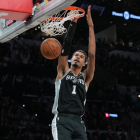
Wizards blog Bullets Forever broke down what on the surface appears to be the struggles of Washington Wizards guard Bradley Beal in his six games since coming back from injury this season, and did an astute job of it. A selection from the whole thing you should read:
Cornerstones to build around like Beal and Wall are always good, but the way Beal has played through six games this season does not necessarily prove he deserves a max deal. The sample size is small, sure, but we have seen these problems before for Beal.
Beal is posting career lows in PER and offensive efficiency so far through the season. Although he is shooting 44% from the floor, his true shooting percentage is just 52%. Beal only gets to the line 2.2 times per game and is taking just 5.5 three point shots per 100 possessions.
These are not good signs for a player who will almost certainly get a max deal. Beal's numbers and his play so far this season suggests that he's a middle of the pack shooting guard - at best.
Beal will surely get a max deal because of the skill set he brings to the basketball court as an elite three point shooter and a secondary ball handler- something many teams in the league are starving for. Though he may not take as many threes as he should with the Wizards, Beal has consistently been a greater than 40% shooter from deep. His form has always been pretty and he's developed skill in the pick and roll game.
There is an enormous difference between where Beal is right now and where Beal should be. His playing style suggests that he's a sub-par shot chucker who hijacks the offense when he see's fit, but it is important to keep in mind that this is a team coached to take the first open shot it finds.
via What Bradley Beal needs to improve upon to be a max player - Bullets Forever.
This got me curious as to what Beal's effect has been on the floor, both cumulatively with Washington, and individually in terms of the offense. And while six games is nothing to build a steady sample off of, I did want to talk about it because some interesting things popped up.
The biggest problem with Beal's game last year had less to do with Beal and more to do with Randy Wittman and his penchant for coaching the Wizards into mid-range jumpers because they're open and basically, Wittman's of the coaching philsophy that any open shot is a good one, despite the fact that if you historically don't shoot that shot well, that's basically like me saying I should be able to hit a target with a bow and arrow if there's no wind, despite the fact that I suck at archery.
Or to put it another way, Beal's a phenomenal shooter and yet the Wizards kept encouraging him to pump-fake and then go inside for a lower percentage shot (and off-the-dribble mid-range 2 vs. a catch-and-shoot three, even with a defender closing). So I wanted to see what kind of shots Beal is taking since he's struggling. And this is what we find. First, from NBA.com, this is Beal's shot distribution. This has nothing to do with makes, only where he's taking them. (Click to enlarge.)

Beal's taken over 12 percentage points fewer shots from mid-range this season, while dramatically increasing his drives to the basket, short-range shots, and shots above the break. He's taking fewer corner threes, but that in large part could be attributable to how the defense is scheming the Wizards when he's in the corner, or the new additions to the Wizards.
Here's a look at Beal's heatmap in the measley six games we have to look at, via NBASavant:

Again, notice the scarcity of mid-range shots, and the more even distribution at the rim and on the outside. The lack of corner threes is a concern, but the progress made in eliminating those mid-range shots is positive. Here's a look at the distance of his shots, and how he's shooting them, from Basketball-Reference.com:
Another interesting tidbit on NBA.com. The Wizards are 1.8 points better per 100 possessions with Beal on the floor this season, but that's mostly on account of the Wizards having been good without him (1.7 points per 100 better than the opponent). Year over year, the Wizards so far are 1.5 points better with Beal on the court than they were with him last year.
And when you look just at the offense, you see even bigger gains, with the Wizards scoring 105.1 points per 100 this season with Beal on the floor vs. 103.8 last year. Obviously, all of these numbers are subject to sample-size theatre, but what, even in this tiny sample, do they indicate?
Beal is taking a smaller percentage of possessions, which is no surprise with him working his way back from the wrist injury and with the addition of Paul Pierce. But he's also operating as somewhat of a pure shooter, which may be a better role for him, as far as this year's Wizards team goes. There's time in coming years for him to do as Klay Thompson has done and add to his game off the dribble. Paul George did much the same thing after not being able to do any of it in his early seasons. Instead, Beal can be a bigger boon to the Wizards by focusing on being a perimeter threat in order to create more space for his teammates, than by trying to produce so much on his own.
Beal was a hero of last year's playoff run, but he doesn't have to be that night in and night out. In fact, the Wizards don't need him to be. His early struggles with turnovers shouldn't detract from his increase in True Shooting percentage (factoring threes and free throws) and a smarter, more stable shooting approach. We'll keep track of this as the season goes on to see if Beal is keeping up with what should be the plan.