Are College Football Playoff byes really the problem? Debunking the narrative layoffs are startling issue
Teams with byes are 1-7 in the first two years of the 12-team CFP format, but let's add some context to that record

By
Tom Fornelli
•
8 min read
Are bye weeks bad? They've existed in professional sports for decades, as well as postseason college basketball tournaments, and the results there give a pretty definitive answer: Nope!
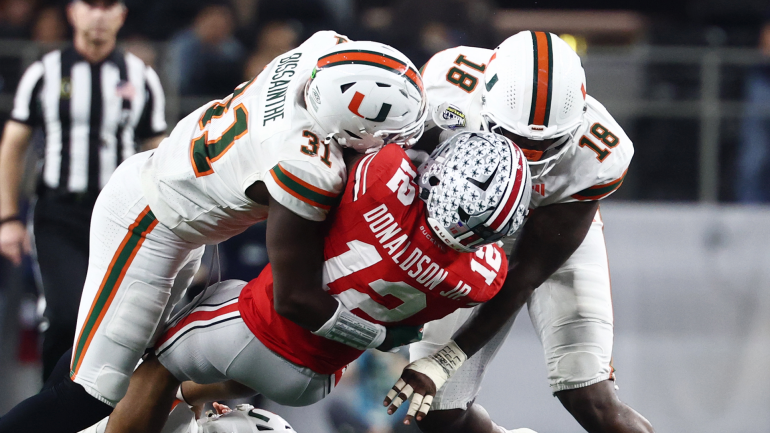
However, in college football, where the 12-team playoff is new, the discussion has been much different. Last year, in the first season of the 12-team College Football Playoff format, all four teams that received a first-round bye lost their quarterfinal matchup. This season, things weren't much different, as No. 1 Indiana's 38-3 win over Alabama means that teams with a bye are now 1-7 in the quarterfinals of the CFP.
But, you already knew that. It's a record that's been parroted by everybody a million times already. It's usually accompanied by a statement like, "the byes are putting teams at a disadvantage," or "we have to get rid of these byes by adding more teams! It's not fair!"
I wrote last year that the discussion may have been coming from the right place, but it was reactionary and, frankly, wrong. Two of the teams that received first-round byes last year -- Boise State and Arizona State -- were double-digit underdogs in their matchups; they were never supposed to win them. In the Rose Bowl, the way Ohio State blew Oregon out of the water was a surprise, but Ohio State was favored to win that game as well. In the Sugar Bowl, Georgia was starting Gunner Stockton for the first time after Carson Beck suffered a season-ending injury in the SEC Championship Game and lost to a Notre Dame team that reached the title game.
Those weren't byes as much as circumstances. This year, things are a bit murkier, but they still aren't as clear as "byes are bad." Let's break the arguments down a little deeper than that.
What's next for Georgia after CFP loss? Latest Sugar Bowl mishap another disappointing end for Kirby Smart
Brad Crawford
Argument 1: Teams off byes get off to slow starts
You probably saw the stat during the Rose Bowl. When the first quarter ended 0-0, the television broadcast showed a graphic telling you that teams coming off a bye had been outscored 45-3 in the first quarter of the first seven CFP quarterfinals. It's a great stat! One worth paying attention to, but the kind of attention that requires far more than just looking at the number and saying, "wow!"
The first clue should've been the literal game you were watching at the time. Yes, Indiana failed to score in the first quarter, but it was in the midst of a 16-play, 84-yard drive at the time. Seriously, the first play of the second quarter was Indiana kicking a field goal to go up 3-0. By the time the quarter had ended, Indiana had 80 yards of offense to Alabama's 18. For some reason, nobody was talking about Alabama's slow start despite not having a bye (not to mention Alabama's slow start against Oklahoma in the first round despite being the team with the shorter rest period in that game, too).
But let's dig deeper into that 45-3 stat. You see, the truth is, 42 of those 45 points were scored by three teams. Texas, which was a double-digit favorite over Arizona State, led the Sun Devils 14-3 after the first quarter of their game last year. Penn State, another one of those double-digit favorites, led Boise State 14-0 after the first quarter in their game. Then there was Ohio State, a smaller favorite, which jumped out to a 14-0 lead over Oregon in last year's Rose Bowl.
Last year's Sugar Bowl between Notre Dame and Georgia was 0-0 after the first. This year's quarterfinals looked much the same. I already told you Indiana and Alabama were tied 0-0 after the first, and so were Miami and Ohio State. Oregon led Texas Tech 3-0 after the first quarter of the Orange Bowl. Ole Miss actually had the biggest edge, taking a 6-0 lead against Georgia in the first quarter.
So this year's bye teams all failed to score in the first quarter, which suggests the slow starts are a thing, just not to the level that 45-3 stat (which is now 51-3) leads you to believe. That's what happens when you're dealing with a small sample size; a few results can skew the entire thing. Still, there is merit to the argument about the slow starts, and I agree 100% with the idea that teams having 24 or 25 days off between games is not ideal. It's tough to adjust from playing once a week to sitting around for nearly a month, particularly during the holiday season when there are plenty of outside distractions.
Still, I don't believe the bye is the culprit here as much as the calendar. If the playoff didn't take so much time off following the end of the regular season, that would probably do more to mitigate these slow starts than anything.
Argument 2: First-round winners have momentum
This is slightly in concert with our first argument. Again, the teams that played in the first round this season only managed to score nine points in the first quarter of the four quarterfinal games, and none scored a touchdown. If we want to look at halftime scores, the cumulative scores of our four quarterfinals saw the teams that received the bye outscore those that didn't 38-32 in the first half. However, like that 45-3 stat, the number is skewed by Indiana and Georgia being responsible for all 38 of the bye team's points.
We can dismiss this one pretty easily.
Argument 3: The results have mostly gone as expected
Take away the byes and look at the games in a vacuum. As I mentioned earlier, in last year's games, two of the teams that lost after being on a bye were double-digit underdogs. Another was forced to start its backup quarterback, and then there was Oregon, facing an Ohio State team that flipped the switch to Juggernaut Mode in the playoff.
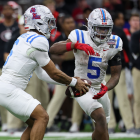
This year, the biggest difference is that we saw two upsets. Ole Miss was a touchdown underdog to Georgia and won that game, but the bye wasn't the problem there. Remember, Georgia led that game 21-12 at halftime. Ole Miss just outplayed the Bulldogs in the second half, with Trinidad Chambliss showing an ability to pull rabbits out of hats in a way we haven't seen since the year Johnny Manziel won the Heisman Trophy. Also, while the result was different, the game looked a lot like the regular-season meeting between the two, which Georgia won 43-35. Let the record show neither team was coming off a bye in that game!
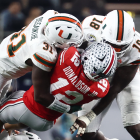
As for the other upset, Miami pulled off the biggest one in College Football Playoff history. The Canes were 9.5-point underdogs at kick and proceeded to kick the crap out of Ohio State for 60 minutes. But was it the bye, or is Miami just good? Remember, this same Miami team went on the road in the first round and beat Texas A&M in a game between two teams with the same amount of rest, as neither played in their conference championship games. Another point in the "maybe Miami is just good" debate: the Canes are favored against Ole Miss in the Fiesta Bowl despite being the "last team in" the field. There's a reason the committee put them in, even if it was a bass-ackwards process.
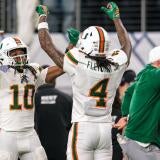
The Orange Bowl was an interesting case. Oregon had been favored against Texas Tech during the entire lead-up to the game, but the line flipped in some spots by kick. Either way, whether Oregon was favored by a point or Tech was, the game was seen as a coin flip, and the final score was very misleading.
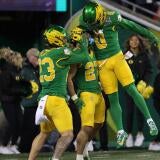
Oregon wasn't coming off a bye, but its offense looked stuck in the mud anyway. After putting up 51 points on James Madison, the Ducks' offense managed only two touchdowns in the game, and one came with 16 seconds left and the outcome decided. Furthermore, Oregon's second-quarter field goal came after a Texas Tech fumble at its 26-yard line. Oregon's offense went nowhere before settling for three points. The final score was more the result of Texas Tech's offense doing nothing, turning the ball over constantly and the incredible defense finally wearing out.
To be clear, though, the bye probably didn't impact Tech's offense much. As I talked about on the Cover 3 Podcast all week, this wasn't a good matchup for Tech. It's an offense that was boom-or-bust the entire season. It simply couldn't function without explosive plays to keep drives alive or to score touchdowns due to its struggles in the red zone. Well, Oregon's defense was one of the three best in the nation at limiting explosive plays, and that's precisely what the Ducks did in the Orange Bowl.
Oregon took away all the big plays except one 50-yard run, and Tech was helpless. That wasn't the bye, that was the matchup.
What's next for Texas Tech? Fixing Red Raiders' offensive shortcomings should be primary focus of offseason
Shehan Jeyarajah
Conclusion
The byes don't help as currently constructed, but they aren't the problem. Yes, the 1-7 record for teams off a bye is startling, but the sample size matters. If Steph Curry goes 1 of 8 from three in his next game, Steve Kerr isn't going to tell him to stop taking threes. Teams that receive byes should be grateful to have them and should continue playing for them.
They have proven to be of great benefit in every other postseason format across sports where they exist.
Last season, the biggest problem with the byes was who received them. Reserving them for conference champions led to two overmatched teams getting them. Now, it looks like the next problem to overcome is the calendar. There is plenty of merit to the idea of moving the games up in the calendar. Yes, this will disrupt the long tradition of playing big bowl games on New Year's Eve and New Year's Day, but plenty in this sport has already changed. If the Rose Bowl or other bowls don't want to stop playing on New Year's Day, they don't have to. We can still schedule incredible bowl matchups for those games featuring teams that didn't reach the College Football Playoff.
But perhaps that's another possible solution. We have four home games in the first round. Maybe it's time we extend that benefit to the teams who earn byes, too! There really is no logical reason why Indiana, Ohio State, Georgia and Texas Tech weren't given the chance to host a playoff game. Whether the field expands to 16 or not, the first two rounds -- at minimum -- should be played on campus. You'd be amazed at how much less rust teams show when playing in front of their home crowd.