Top 10 MLB storylines for 2026: World Baseball Classic, Dodgers' shot at history, a looming lockout and more
What's in store for 2026 as the calendar flips?

By
Dayn Perry
•
16 min read
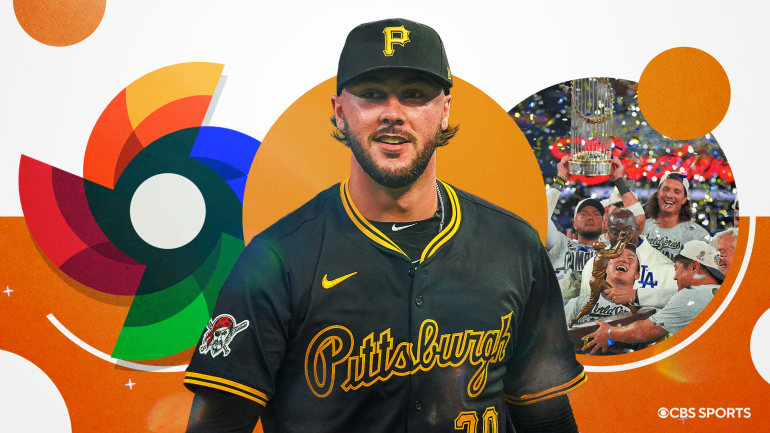
Time, in defiance of good taste and our fondest wishes, continues its forward march, and whether we like it or not the year 2026 is upon us. The flip of the calendar from 12th month to first of course occasions all manner of look-backs, but in our case we're looking boldly ahead -- ahead to what 2026 promises baseball fans and observers within its boundaries.
To set the scene for 2026 insofar as Major League Baseball is concerned, we're here to roll out the 10 storylines that figure to dominate headlines over the next 12 months. There's always room for the unexpected, of course, but as things stand now here at the start these major plot points seem like the best bets to define the year in baseball to come. Onward, not unlike cruel time itself.
1. The remains of the market
Yes, the new year has arrived, and big-name free agents and trade targets are still available. The first big story of 2026, then, will be where those talents wind up before the season begins. Thanks to the, ahem, methodical pace of the offseason thus far, our top four ranked free agents and six of the top 10 are still available for hire. Those big names include Kyle Tucker, Alex Bregman, Bo Bichette, Framber Valdez, Cody Bellinger, and Ranger Suárez. Overall, 17 of the top 50 free agents, as ranked by CBS Sports, are looking for work as the new year arrives.
On the trade front, Brendan Donovan and Nolan Arenado of the Cardinals are still on the block, and Ketel Marte of the Diamondbacks is perhaps alongside them. Will the Brewers deal away ace Freddy Peralta? Will the whispers of a Tarik Skubal blockbuster grow louder as we work our way toward the spring? What about all those starting pitchers in Miami? Trade candidates abound, and not many of them have been dealt yet. All of this is to say that the early days and weeks of 2026 should bring us quite a bit of headline-grabbing player movement.
2. The World Baseball Classic
The year 2026 in baseball will get off to a lapel-grabbing start as the next installment of the World Baseball Classic gets underway in earnest with pool play in early March. That all leads up to the to the March 17 championship game at Miami's loanDepot Park:
Announcing the pools and schedule for the 2026 #WorldBaseballClassic!
— World Baseball Classic (@WBCBaseball) August 21, 2024
The opening round starts March 5, quarterfinals start March 13 and the championship round begins March 15! pic.twitter.com/tT5h848dcs
History informs the present, of course, and let's note that Japan will be aiming to defend its WBC title and win the tournament for the fourth time overall:
| Year | Final Host | Champion (Gold) | Score | Runner-Up (Silver) | Third (Bronze) | Fourth |
|---|---|---|---|---|---|---|
2006 | San Diego | Japan | 10-6 | Cuba | South Korea | Dominican Rep. |
2009 | Los Angeles | Japan | 5-3 (F/10) | South Korea | Venezuela | United States |
2013 | San Francisco | Dominican Rep. | 3-0 | Puerto Rico | Japan | Netherlands |
2017 | Los Angeles | United States | 8-0 | Puerto Rico | Japan | Netherlands |
2023 | Miami | Japan | 3-2 | United States | Mexico | Cuba |
As for this latest installment of the WBC, it's shaping up to be the biggest and most talent-packed version of the tournament yet. The 2026 event will again feature 20 national teams, with pool play spread across multiple international sites before the knockout rounds. The overall format will remain familiar: round-robin pool play followed by single-elimination quarterfinals, semifinals, and then the championship game.
What increasingly separates the upcoming WBC from its predecessors -- or any other international baseball event -- is player buy-in, and that momentum is real. Reigning WBC MVP Shohei Ohtani will be back for Team Japan, for starters. The real separator is the quality of the Team USA rotation. Most notably, each reigning Cy Young winner, Tarik Skubal of the Tigers and Paul Skenes of the Pirates, will be fronting a rotation that also includes the ace-ish likes of the Giants' Logan Webb and the Twins' Joe Ryan. Also in manager Mark DeRosa's quiver are Matthew Boyd of the Cubs and Clay Holmes and Nolan McLean of the Mets. Being able to trot out the best two pitchers in baseball during the WBC stands in sharp contrast to what Team USA passed off as a rotation in 2023. Throw in a powerhouse lineup, and the U.S. is already the pre-tourney favorite (+140 to win, per DraftKings). Ohtani and Japan, though, will have something to say about that.
From a belt-and-title standpoint, Japan remains the standard, but perhaps that gap is shrinking. The Dominican Republic, Venezuela, Puerto Rico, and of course the U.S. all have the depth to win the tournament, while teams like Mexico and Korea have proven they can make deep runs. Expanded global development has turned the WBC into something closer to a true international showdown rather than a predictable hierarchy.
Culturally, the WBC occupies a space MLB struggles to create on its own -- urgency, identity, and joy. Dugouts are louder. Games feel sharper. The stakes feel real even in March. The 2026 World Baseball Classic isn't just a preseason exhibition anymore. It's baseball reminding itself -- and everyone else -- how electric the sport can be when pride, talent, and competition collide.
3. The ongoing A's relocation drama
The 2026 season marks year two of the Athletics calling Sacramento their temporary home. It's all a prelude -- awkward, ill-fitting prelude -- to John Fisher's profoundly cynical Las Vegas relocation endgame. The plan, such as it is, is for the A's to play two more seasons at the Triple-A ballpark in West Sacramento before moving into their new Las Vegas digs in time for the 2028 season. The A's have indeed broken ground at the Las Vegas site, and they've set up a "ballpark construction cam" and all that. That gives it all the veneer of fait accompli, but the fundamental obstacle remains the same: money.
Las Vegas and environs are -- unwisely, of course, as is always the case with such projects -- kicking in a bit less than $400 million in direct public funds, which means Fisher and the A's are on the hook for the remainder. That, in turn, means that Fisher and the A's must contend with increasing construction costs, which put the total price tag for the Vegas venue at $2 billion or so. For his part, Fisher claims to have committed $1.1 billion of his own money (read: his parents' money) toward the project and claims to have secured a loan for a chunk of the outstanding balance.
Given the ricketty nature of the funding thus far and the dubious proposition to abandon the Bay Area for what will be MLB's smallest media market, it's still fair to wonder whether all of this actually comes to pass. On that point, note the feebly imprecise language used by team vice chairman Sandy Dean in early December regarding the funding of the project:
"I think the most important thing is that, starting in December of 2024, we were able to describe the financing for the stadium as being complete."
Given what's happened to date, the default assumption is that the ballpark will eventually be constructed and that the A's will eventually play there. Still, it's hard to doubt Fisher's incapacity for planning and general functional incompetence, which means nothing is to be assumed until the park is open and the A's take the field there. On that front, the year 2026 figures to bring further clarity to the ugliest thing going in MLB right now.
4. The first year of the ABS system in the majors
Automated ball-strike (ABS) systems have been used at various rungs of the minor leagues for the past few years, and in 2026 an ABS system will be used in the MLB regular season for the first time ever. It's frankly overdue, as plate umps have proved incapable of calling pitches on the edge with anything close to an acceptable rate of accuracy. Since 2008, plate umpires have called pitches defined as "on the corners" correctly just 47.6% of the time, according to TruMedia data. Yes, it's understandable given the absurd velocities and late, sharp movement employed by contemporary pitchers, but it's mangling the game.
In that sense, the "challenge system" that's going to be in place may be a half-measure. MLB has the capability to implement full automation when it comes to calling balls and strikes, but instead they're letting the human umps make the vast majority of ball-strike calls. The exception will be when the batter, pitcher, or catcher on behalf of the pitcher challenges a call. At that point, the ABS system will do its thing. It'll go a little something like this:
How soon will we as observers adjust? There was a time when the pitch clock and universal DH seemed like radical departures for a sport so yoked to tradition, and we all got over those in short order. Most of us realize that the human element is for the players playing the game and those charged with applying the rules. Other ABS questions that will be answered by the time the 2026 season is done … Will we have an awkward ABS moment to end a high-stakes game, maybe even a World Series game? If a team has remaining challenges on the final pitch of a game, why not challenge a punch-out or a ball four? Will use of the challenge system in its debut season make it seem like a fixture or merely the foundation for a full ABS system?
5. The White Sox and the No. 1 pick
The White Sox, coming off a 102-loss season in 2025, prevailed in the MLB Draft Lottery, which means they'll have the top overall pick this summer. This will mark just the third time in franchise history that the South Siders have held the top selection. The previous two were a mixed bag. In 1971, they took catcher Danny Goodwin, who never appeared in the majors for them. Six years later, though, they plucked a prep first baseman out of Maryland named Harold Baines, who went on to become a franchise legend and a Hall of Famer. Baines, not coincidentally, repped the White Sox at the lottery drawing in December.
In a sense, calling the first name of the 2026 MLB Draft will ideally be the capstone on the deep rebuild undertaken by Sox general manager Chris Getz. It hasn't been the smoothest process, but Chicago has indeed amassed an impressive stable of young talent and positioned themselves to matter soon in the eminently winnable AL Central. But who will that pick be?
Going into the 2026 amateur season, which will of course heavily inform the 2026 draft, UCLA shortstop Roch Cholowsky is the early favorite for top-pick honors. Here's part of our RJ Anderson's breakdown of Cholowsky:
"A lot can change by the time February rolls around, but Cholowsky is the early favorite to enter next spring atop my draft rankings. He's a fluid athlete (he was recruited to play quarterback at Notre Dame) with a good feel for both the position and the game overall. (I'm certain scouts took notice when he pushed a bunt through Iowa's infield and legged out a double during the Big Ten tournament.) Cholowsky isn't just a plus glove and set of wheels at a premium position: he's a compelling offensive prospect, too, as evidenced by him leading UCLA in home runs, average, on-base percentage, and slugging percentage -- all while walking 15 more times than he struck out. Again, there's a lot of road between now and February, but I consider Cholowsky to be in the lead."
If indeed Cholowsky is the choice, then he'll almost certainly be a fast mover through the system and may arrive in Chicago right around the time they're ready to contend again.
6. The Dodgers and back-to-back-to-back World Series titles
The juggernaut Dodgers in 2025 became the first team since the 1999-2000 Yankees to win consecutive World Series titles. That sets the stage for 2026, when the Dodgers will attempt to join the even more exclusive ranks of those clubs to win three or more titles in a row.
Here's a look at the company the 2026 Dodgers will look to keep:
| Team | Consecutive World Series won |
|---|---|
1998-2000 New York Yankees | Three |
1972-74 Oakland Athletics | Three |
1949-53 New York Yankees | Five |
1936-39 New York Yankees | Four |
As you can see, just four squads have pulled off a three-peat (or more) across all of MLB history, and the Dodgers can become the first National League franchise to do so. While one should always take the field in a sport like baseball over any one team in a given year, the Dodgers will not surprisingly be very well positioned to make a run at the above list in 2026. Shohei Ohtani is of course back (more on him in a moment), as are Freddie Freeman, Mookie Betts, Will Smith, and a rotation stuffed with frontline starters. On another level, the Dodgers are in a class of one when it comes to ownership's willingness to invest in the on-field product and the front office's willingness to use those resources.
Sure enough, not long after the Dodgers hoisted the 2025 trophy, they turned up as the betting favorites to win that third straight championship in 2026.
7. Shohei Ohtani and four straight MVPs
Dodgers two-way living legend Shohei Ohtani too is in a class of one when it comes to many things on a baseball field. In 2026, though, he can join a fellow traveler on the MVP award front. That's because he has a shot at winning his fourth straight MVP in 2026; at present, the only player to achieve such a feat is Barry Bonds of the Giants from 2001-04.
Ohtani won the American League MVP in 2023 as a member of the Angels, and then he won again in 2024 with the Dodgers as he authored the first 50-50 season in MLB history. His third straight win came in 2025 when he mashed a career-high 55 home runs at the plate and also returned to the mound to make 14 starts for L.A. Ohtani and Bonds are already the only players to win four or MVPs (Bonds won seven times), although Aaron Judge may join their ranks in 2026, and now Ohtani can join Bonds in the equally exclusive four-in-a-row club. If Ohtani pulls that off, that will give him five MVP awards in nine MLB seasons.
It's of course early yet, but Ohtani's competition for the National League's top individual honor figures to come from some combination of Juan Soto, Fernando Tatis Jr., Ronald Acuña Jr., Elly De La Cruz, Kyle Tucker (if he winds up back in the NL), and maybe even Paul Skenes, who happens to be up next.
8. Paul Skenes Watch
First and most essentially, this is about what Skenes can accomplish in his third MLB season, his age-24 season. Quite absurdly, through the first 55 starts of his big-league career, the big right-hander boasts an ERA+ of 217, an ERA of 1.96, an FIP of 2.40, a K% of 31.0, and a WAR of 13.5. This, without an exaggeration, is one of the greatest starts to a pitching career across the full annals of baseball history. In partly related matters, Skenes last season was the unanimous choice for NL Cy Young laurels at the age of 23.
That brings us to 2026. He'll enter the season as the favorite to win the Cy for the second time. If he pulls that off, then Skenes will tie Roger Clemens as the youngest pitcher to win multiple Cy Young awards and the youngest pitcher to win consecutive Cy Young awards. Enviable company, that, at least as on-field results go.
The other part of the Skenes story will come after the 2026 season, no matter how that plays out for Skenes and the Pirates. Because of Skenes' otherworldly excellence and star power and the Pirates' demonstrable lack of seriousness as a major-league franchise -- a reflection of Bob Nutting, their truly terrible owner -- trade speculation has been a lamprey upon Skenes almost from the moment he arrived in Pittsburgh. To date, this has all been a bunch of idle wish-casting and peddling of poorly sourced rumors. However, eventually the signal-to-noise ratio will increase as Skenes moves closer to free agency. After the 2026 season, Skenes will be eligible for arbitration and be down to three years of remaining team control. If he reaches that juncture with a second Cy in hand, then you can expect the trade chatter to pick up and, unlike in previous offseasons, there will be the whiff of semi-legitimacy to it. That doesn't mean the 2026-27 offseason will bring a Skenes monolith of a trade, certainly, but the momentum toward one will be all but palpable. The Pirates, of course, can alter that script by trying to win in 2026 (the Brandon Lowe addition is a reasonable start) and making a good-faith effort to sign Skenes to an extension, but that seems unlikely. What's much more likely is that we'll be talking quite a bit about Skenes in 2026 for a variety of reasons.
9. The 2026-27 free agent class
Soon after the Dodgers fail or succeed in their three-peat bid, we'll do this free agent thing all over again. The next class of free agents, barring any extensions and depending upon which club and player options are exercised, may include some big names like Tarik Skubal, Jazz Chisholm Jr., Nico Hoerner, Randy Arozarena, George Springer, Seiya Suzuki, J.P. Crawford, Ian Happ, Daulton Varsho, Chris Sale, Brandon Woodruff, Kevin Gausman, Freddy Peralta, and David Bednar. As well, Corbin Burnes, Michael King, Nick Pivetta, Clay Holmes, and Ryan Helsley are among the players with opt-outs after next season.
Overall, the class is light on impact bats, but any crop of free agents that includes the likes of Skubal is worth our attention.
Let's note that the 2026-27 offseason doesn't figure to be a normal one in terms of player movement, if such a thing even exists anymore. That's because of the specter of our final 2026 storyline.
10. The looming labor war
At some point after the current collective bargaining agreement (CBA) expires on Dec. 1, 2026, MLB will likely lock out the players, just as they did in the spring of 2021. We know this because commissioner Rob Manfred has all but said as much. In early 2025, Manfred said this of the possibility of a second straight lockout:
"In a bizarre way, it's actually a positive. There is leverage associated with an offseason lockout, and the process of collective bargaining under the NLRA (National Labor Relations Act) works based on leverage. The great thing about offseason lockouts is the leverage that exists gets applied between the bargaining parties."
Last time, the league narrowly avoided having to cancel games during the 2021 season, as the lockout sprawled for 99 days. The fear this time around, however, is that labor strife will eat into a season for the first time since the nuclear-grade stoppage of 1994-95.
As is always the case, the fight between owners, as represented by the league, and players, as represented by their union the MLBPA, will be over money -- how's it divided up and even what counts as baseball-related revenue. More specifically, owners are expected to press once again for a salary cap, and there remains effectively no chance that players will agree to one. MLB is the only non-capped league among the four major North American sports and baseball owners can scarcely conceal their envy of their capped-league counterparts. Players, though, will no doubt note that the CBT already serves as a brake on the highest payrolls and posit that MLB's (wholly overstated) competitive balance issues flow from teams that are unwilling to spend as opposed to those who invest in their rosters. Owners, though, are far more concerned with suppressing labor costs than anything else, and a cap allows them to do that while costuming it all as a push for more parity.
It takes a house union -- a broken union -- to agree to a cap, and the MLBPA isn't that. The extent to which owners are willing to bow to this reality will go a long way toward determining how long the all-but-inevitable lockout lasts. Manfred takes pride in having never lost a game to labor troubles during his tenure, but his bosses may imperil that important plank in his legacy. We'll know more -- perhaps more than we want to know -- as 2026 draws to a close.