Agent's Take: What's next for the Colts and Daniel Jones after his Achilles injury?
Jones' Achilles tear leaves both his future and the Colts' quarterback plans in doubt
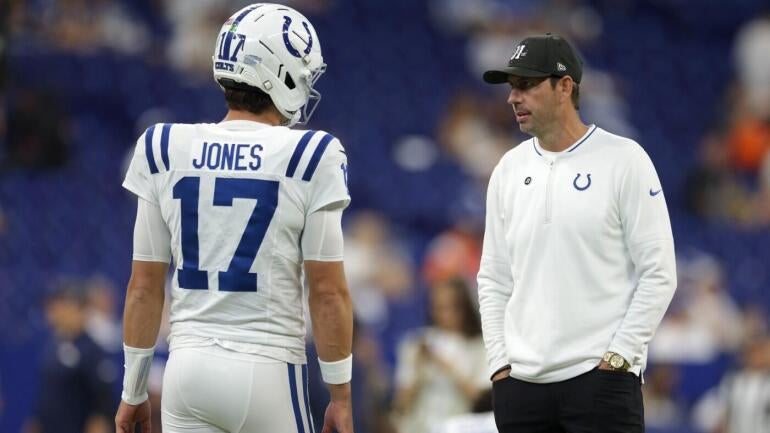
A dream season for the Indianapolis Colts has turned into a nightmare. At 7-1, they looked poised for a deep playoff run behind the NFL's best record and an explosive offense averaging a league-leading 33.8 points per game.
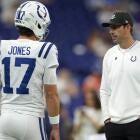
Quarterback Daniel Jones, signed to a one-year, $14 million deal worth up to $17.7 million, was enjoying a stunning career resurgence and emerging as an early MVP candidate. Through eight games, he threw for 2,062 yards with 13 touchdowns and two interceptions while completing 71.2% of his passes (173 of 243) for a 109.5 rating. He ranked third in completion percentage, fourth in passing yards and fifth in passer rating league-wide.
Believing Jones had finally stabilized a position that's been unsettled since Andrew Luck's abrupt 2019 retirement, the Colts went all in at the Nov. 4 trade deadline. They acquired All-Pro cornerback Sauce Gardner from the Jets in exchange for their 2026 and 2027 first-round picks and wide receiver Adonai Mitchell — a win-now move that signaled full commitment to the 2025 season.
But the unraveling began soon after. Jones' play dipped as a fracture in his left fibula sapped the mobility central to his game. Gardner is now out indefinitely with a left calf strain. And Jones' season ended in Week 14 when he tore his right Achilles early in a 36-19 loss to the Jacksonville Jaguars.
The quarterback room is now in disarray. Anthony Richardson, the No. 4 pick in 2023 who lost a preseason competition to Jones, remains on injured reserve with an orbital fracture suffered in a freak elastic-band accident before Week 6. Rookie sixth-round pick Riley Leonard is dealing with a PCL sprain in his right knee from the Jaguars game.
Out of desperation, Indianapolis signed 44-year-old Philip Rivers to the practice squad. Rivers last played in 2020 -- as the Colts' starting quarterback.
After losing four of five to fall to 8-5, Indianapolis is suddenly in danger of missing the postseason. The remaining schedule offers no relief: Seattle, San Francisco, Jacksonville and Houston -- a quartet with a combined .692 winning percentage -- all would be in the playoffs if the season ended today.
Colts face limited alternatives at QB
Jones' injury puts his future with the Colts in jeopardy. Without first-round picks, it becomes far more difficult for Indianapolis to pivot to a new quarterback through the NFL Draft -- and there may not have been much appetite to go that route anyway after spending a top-five selection on Richardson. The 2026 quarterback class is considered mediocre at best.
There aren't great alternatives in free agency. Aaron Rodgers, now 42, was fairly certain 2025 would be his final NFL season when he signed with the Pittsburgh Steelers in June. Beyond Rodgers, the top options are Marcus Mariota (Commanders), Kenny Pickett (Raiders) and Tyrod Taylor (Jets). Joe Flacco, Gardner Minshew and Carson Wentz -- all of whom previously spent time with the Colts -- will also be available.
Mac Jones would be the best trade option. He kept the 49ers afloat during the eight games Brock Purdy missed with a turf toe injury and will be entering a contract year in 2026, when he's scheduled to make $4.66 million. With the modest salary and a shallow quarterback market, San Francisco should have leverage in any Jones trade talks.
Kyler Murray is another potential trade candidate, as his time in Arizona appears to be nearing an end. Acquiring him would effectively lock a team into a two-year, nearly $79 million commitment due to the structure of his deal. Murray's 2026 salary is $42,542,500, including $36.8 million fully guaranteed. Of the $36.335 million he's scheduled to earn in 2027, his unsecured $19.5 million base salary becomes fully guaranteed on March 15, the fifth day of the 2026 league year.
Jones' recovery outlook and 2026 future
The quarterback landscape sets up for Jones to return to Indianapolis for at least the 2026 season. Before the injury, his camp was likely to seek a deal exceeding the four-year, $160 million contract he signed with the New York Giants in 2023 -- particularly if the Colts planned to use the franchise tag. That contract averaged $40 million per year, included incentives and escalators pushing it to $195 million, and contained $104 million in guarantees, with $81 million fully guaranteed at signing.
A non-exclusive franchise tag in 2026, which was a realistic possibility prior to the injury, is projected to cost 14.576% of that year's salary cap (compared to 14.413% in 2025). If the 2026 cap lands at $300 million -- a 7.45% increase over 2025's $279.2 million -- the tag for quarterbacks should come in around $43.278 million.
The timeline for Jones' recovery remains unclear, though it isn't out of the question that he could be ready for the start of the 2026 regular season. There are recent examples of relatively fast returns from Achilles injuries. Cam Akers came back in just 5½ months after tearing his Achilles in 2021 and became the lead back for the Rams' Super Bowl LVI run. J.K. Dobbins considered himself fully recovered roughly eight months after his 2023 Achilles tear and opened the 2024 season with back-to-back 100-yard games before a separate MCL sprain slowed him, preventing him from having his first 1,000-yard season.
Quarterback recoveries provide an even closer comparison. Kirk Cousins tore his right Achilles in late October of the 2023 season, passed his training-camp physical the following July and opened the 2024 season as the Falcons' starter. Jones, who turns 29 in May, is nearly nine years younger than Cousins, so he could heal even more quickly.
Evaluating Jones' contract value after the injury
It wouldn't be surprising for Jones' camp to push for business as usual financially despite the injury. Before he went down, Jones was having the best season of his career. His 68.0% completion rate, 238.5 passing yards per game and 100.2 passer rating were all career highs.
Cousins is the closest recent contract comp. Less than five months after his own Achilles tear, Cousins received a four-year, $180 million deal (worth up to $188 million) with $100 million in guarantees -- $90 million of which was fully guaranteed at signing -- from the Falcons in 2024 free agency. The $45 million-per-year average made him the NFL's eighth-highest-paid player at the time.
Cousins, however, was far more accomplished, having posted seven 4,000-yard seasons. Jones has yet to reach 3,500 yards in a single year. The Cousins contract now serves as a cautionary tale: his mobility noticeably declined after the injury, and he was benched late in the 2024 season.
A structure similar to the one Drew Brees received when he joined the Saints in 2006 could appeal to Indianapolis if Jones remains viewed as a long-term solution. Because Brees entered free agency with a career-threatening shoulder injury, New Orleans protected itself with a market-rate multi-year deal with the ability to part ways after the first year with minimal salary cap consequences if he couldn't regain his previous form.
The Colts adopted a similar approach with Peyton Manning in 2011 following his neck surgery. As a franchise player, Manning signed a five-year, $90 million deal tying him with Tom Brady as the league's highest-paid player, but Indianapolis had the ability to part ways after one year. Manning missed the entire season, and the Colts moved on after paying him $26.4 million for that one year.
If Indianapolis and Jones' representatives fundamentally disagree on long-term value, Jones' camp might be open to a transition tag in 2026. Under the transition designation, Jones could negotiate with other teams when free agency begins on March 11, and the Colts would have five days to match any offer sheet. If they decline to match, there is no draft pick compensation.
The 2026 quarterback transition tag projects to 12.604% of the salary cap (compared to 12.671% in 2025). With a $300 million cap, that number is expected to be $37.813 million. Even so, Indianapolis may find that figure steep, though it aligns reasonably with the one-year, $25 million deal the team gave Rivers in 2020 when adjusted for cap inflation.
Given the financial risk and uncertainty surrounding Jones' recovery, a two-year contract may ultimately make the most sense. However, the two-year, $40 million deal with $30 million fully guaranteed that Justin Fields received from the Jets is unlikely to satisfy Jones' camp. It's difficult to reconcile that type of contract with the one-year, $28 million extension the Colts gave Jacoby Brissett in 2019, just weeks after Andrew Luck's retirement, despite Brissett being relatively unproven.
A more instructive comparison might be Blake Bortles' 2018 extension with the Jaguars. Bortles received a two-year deal averaging $17,473,500 per season, plus $11.5 million in incentives, when the cap was $177.2 million. The contract carried $26.5 million fully guaranteed. Adjusted for a 2026 salary cap environment, the base value of that deal would fall in the $30 million-per-year range.
A short-term contract at roughly $30 million annually would also align with the marketplace. According to NFLPA data, the average 2025 salary for starting quarterbacks — including those on rookie deals -- is $30,153,958. When rookie-scale quarterbacks are removed, that average jumps to $44,067,508 per year.
Uncertain factors that could shape Jones' future
There would also be a real risk of a quarterback-needy team making a run at Jones if he reaches the open market, injury or not. All bets could be off with a complete collapse where general manager Chris Ballard and/or head coach Shane Steichen lose their jobs.
Another variable is Jones' own financial outlook. Having already secured one major payday, he may be more willing to show some flexibility with Indianapolis. Jones earned $82 million in 2023 and 2024 from his Giants contract alone.