College football turns 150: The biggest names in the sport reminisce on the game they love
From Steve Spurrier to Herschel Walker to Matthew McConaughey, this is how the game is remembered

By
Dennis Dodd
•
15 min read

Here's the thing after 150 years of college football: Everybody's opinion counts. All of their observations are valid. There is enough room in the indoor practice facility of the mind for all the memories, rivalries and interpretations.
If you're 75, you've been alive for only half of the sport's existence. Since none of us were there for all 150 years, we are left with weaving together the stories, scores, recollections and highlights as we see fit. It's called history.
There was a man who tracked every Notre Dame player who stepped on the field for even a second going all the way back to the first game in 1887. Former NCAA statistician Steve Boda died in 2014. He was born in the same Indiana hospital where George Gipp died.
We need to remember those connections to the past.
"I can't quit college football," author and Florida State professor Diane Roberts wrote. "It's like a bad boyfriend. You hate that he's so right-wing, his table manners embarrass you, he's barely read a book, and you don't want your mother to meet him, but damn, he's so fine and makes you feel so good (when he isn't making you feel so bad), you just can't help yourself."
The idea here, in the middle of the sesquicentennial, is preserve a part of America's grand game -- to assemble memories from some of the sport's biggest names. What you will encounter below is the game through their eyes with their voices.
CBS Sports sought the best and brightest in the game to provide their accounts of college football through the years. Some of it is modern day. Some of it is ancient. Hopefully, all of it is interesting. We ended up speaking with more than 20 foremost college football minds in our discussion about the way the game was in the past, is today and will be in the future.
The best way to describe Verne Lundquist's most memorable game is to just let him do what he did best -- tell the story of the Kick Six.
"I know that once Chris Davis got to the end zone and I called it an answered prayer, I didn't even look at Gary [Danielson]. Gary and I had worked together eight years at that point. We didn't even look at each other. We just knew.
"I want you to pay particular attention to what happened when we did lay out. We laid out for a minute, 21 seconds. During that time, [director] Steve Milton made 20 different camera cuts. It was like he was not only creating the symphony, he was directing it and composing as he went along. Every shot in my view … having seen it 100 times, he told a story visually that very, very few men can.
"Two memorable scenes of kids from Alabama reacting in absolute astonishment. He was on Nick Saban when Saban walked away. He was on AJ McCarron [as he] walked away and kissed his girlfriend.
"As Davis crossed into the end zone, I said, 'There are no flags.' I thought for just a fraction of the second, 'Dear God, don't let there be any flags.'"
Urban Meyer has won three national championships, yet he can't forget his first year as a head coach.
"I go to Bowling Green where they've had six straight losing seasons. We had a couple of good workouts and practices. A chunk of [the players] quit. Bo Schembechler said, 'Those who stay will be champions.' That was kind of our mantra. We'll find a way to win. In my heart, I didn't know if I believed it.
"Sure enough, we get on a plane to go to Columbia, Missouri, with a team that a year before quite honestly was awful. The night before I said to [wife] Shelley, 'How long will they keep us if we lose every game?' She said, 'Will you shut up? I bet you win tomorrow.' I looked at her and said, 'We have 53 guys on the plane.' We didn't even have 70 to travel. She says, 'We'll find a way to win that game.'"
Bowling Green beat Missouri 20-13 Sept. 1, 2001.
"When we won, no one knew what to do," Meyer said. "… I've never seen a locker room like that after a game."
The 1969 Texas-Arkansas Game of the Century featured every bit of hype that could be mustered in that era. President Richard Nixon made a dramatic entrance via helicopter. The winner was going to have the inside track to the national championship. The game-winning kick was made by Texas' Happy Feller.
A young Tommy Tuberville was there.
"That game probably taught me more [about getting] into this business than anything that affected me. I was ninth grade when that game was played," said former Auburn coach Tommy Tuberville, who attended the game at age 16. "Maybe one of the gutsiest plays I've seen. Fourth-and-3, Texas calls a go-route."
The resulting 44-yard pass play set up the Longhorns at the Razorbacks 13. Two plays later, Steve Bertelsen crashed into the end zone to tie the game. Feller, that place-kicker, won it.
Tuberville did something that seems unfathomable today -- beat Alabama six straight times at Auburn. Now he has to appeal to both Tigers and Crimson Tide fans while running for one of the state's U.S. Senate seats at age 65.
"It never really dawned on you much when you're coaching. When you're winning championships, it never dawns on you the magnitude of what you've done. Now that I'm riding around the state, everybody wants to talk about it," he said. "Now that I'm out of a coaching job, the significance of winning I feel it a lot more. The impossibility of that happening, a rivalry that big. Nick [Saban], he can't win six in a row as dominant as he's been.
"Somebody asked me, 'Are you going to go by Coach or Senator [if you win]?' I've earned 40 years of being a coach. … I don't think I'll be known any other way."
Former Colorado quarterback Joel Klatt was hooked when he was a child.
"We went up and sat in the north seats in 1985 or '86. I was 4 or 5. We saw the great Barry Switzer team play Colorado. Brian Bosworth was out there. I watched the buffalo run around. I was totally hooked.
"When I was 12 years old and my sister was in a volleyball tournament at Cherry Creek High School, it was in September. My mom takes me, and it's 1994, there was a guy who had a portable TV.
"I watched the Miracle at Michigan on that little TV. The volleyball game is going on and -- in my mind, I want to say there are 20 of us -- in this little high school gym watching this little TV. It happens and we all just erupt. The volleyball game stops and looks up at us, and we're all just high-fiving. I'm 12 years old with grown men."
Clemson coach Dabo Swinney was 10 when a friend's family invited him to watch the 1980 Sugar Bowl in New Orleans.
"Got to go to New Orleans for the first time. I remember walking down Bourbon Street as a kid. I had my Alabama hat, my Alabama jacket and my foam finer. My mom has a picture of me somewhere. I remember dancing with the street people there.
"Watching the 'Bear Bryant Show' on Sundays with his Golden Flake and Coca-Cola. He'd talk about, 'Yeah, there's ol' Dabo from Pelham. I saw his momma today.'"
Now, it can be argued Clemson's greatest rival is that very Alabama program.
"It's like they almost should almost be part of our regular schedule," said former Tigers star Christian Wilkins of playing the Tide in four straight playoffs. "We get used to playing them every year. It's like they're in our conference."
Mack Brown struggled with what to say for his pregame speech before the 2006 BCS Championship Game against USC.
"I told them, 'Listen to me very closely because the next thing that I tell is not only going to help you win this game, it's going to help you the rest of your life.' I've got 'em. You can hear a pin drop.
"'How many of you have ever seen the show 'Jerry Springer?'' All of them threw their hands up. 'I just watched an hour and a half of 'Jerry Springer,' and I learned something very valuable. If your wife or your girlfriend ever asks you to go on that show, don't go.'
"They died laughing."
1982 Heisman Trophy winner Herschel Walker shocked some folks this summer when he revealed how he chose to play college football.
"I grew up in small little town in South Georgia. I never watched football. My greatest joy on Saturday was to watch NWA wrestling with my father and brother. Ric Flair, people like that.
"To get a scholarship to go college was an honor. A lot of people didn't know I was going to the Marines. I ended up flipping a coin. That's how I ended up going to the University of Georgia."
It worked out for Walker and the Bulldogs.
Georgia beat Notre Dame with Walker in the 1981 Sugar Bowl as the Dawgs won their first national championship in 38 years.
"Jim Minter, the longtime editor of the Atlanta Journal-Constitution, said when Georgia fans stormed the field: 'Those feelings I promise you go back to 1865.' It wasn't just a big deal to win the national championship, it was a big deal to beat Notre Dame, that symbol of northern supremacy," shared Mr. College Football, Tony Barnhart.
Notre Dame running back Jerome Bettis went a different direction.
"I had to make a decision in my eighth grade year. I had to kind of figure out what I wanted to do. I had to give myself the best chance to get a college scholarship.
"I decided I would play football and give myself a chance, as opposed to bowling. I think there was only one school at that time that gave out scholarships for bowling -- Ohio State."
If college football is anything, it's regional. Quarterbacks in the West. Wide open offenses in the Big 12. November weather in the Big Ten. There is nothing like football in the South.
"I don't have the exact reason [I went to Florida]. People in Columbus, Ohio, probably tell you it's just as important up there. I just look back and think how fortunate I was to go to the University of Florida," said Heisman Trophy winner and national champion coach Steve Spurrier.
"I didn't know where else to go. I finished [high school] basketball season in late March [in Tennessee]. It was 72 degrees in Gainesville and about 32 in Johnson City."
After a successful run at Kansas State under Bill Snyder, Bob Stoops moved to Florida in 1996 to serve as defensive coordinator under Spurrier. It was there he found out when coaching in the SEC meant.
"Florida-Tennessee was my second game ever at Florida. Danny Wuerffel vs. Peyton Manning. You talk about bonkers, crazy. I just told myself in the middle of the week, 'Ignore all that. Get ready to play like we always play.' I'll be damned if we're not up 35-0 with 10 minutes to go in the second quarter."
Florida survived, 35-29.
Speaking of football in the South.
"An SEC football game is like a knife fight in a ditch. You got a knife, he's got a knife and you got nowhere to go," said Barnhart.
"What's the difference between the SEC Network and Big Ten Network? It's really simple. If you live in the Big Ten footprint and you don't get the network, you are going to call your cable provider and complain.
"But if you live in the SEC footprint and you don't get the SEC Network, somebody's house is going to get burned down."
ESPN's Paul Finebaum has the pulse of a conference, a region and the people that populate it.
"Right after the 2009 championship, I came back from the Rose Bowl, and I was in a Walmart and a guy stopped me. This is only three days later. He had his cart filled as high as you could stack with Alabama hats and shirts and pennants. He introduced himself. 'Mr. Finebaum, I am from Bangladesh, and today I am an Alabama fan. ' He struggled to speak English and he bought in. He was as welcome to the Alabama family as somebody whose father and grandparents played at Alabama.
"That story I just told you is applicable in a lot of states in the South, just depending on the year."
Jimmy Johnson is 76. He is known to a generation of fans as a Fox NFL analyst. But as the Miami Hurricanes coach from 1984-88, he was in charge of one of the most powerful programs in history. It still sticks with him the way a 1988 meeting with Notre Dame ended.
"The controversy my last year at Miami when the Big Ten official called Cleveland Gary for fumbling at Notre Dame. We end up losing 31-30 and gave Lou Holtz the [1988] national championship.
"All the Miami fans, including myself, felt like we should have won the national championship with an undefeated team. We've watched the replay a thousand times. It was one of two choices: Either [Gary's] knee was down on the 1-yard line or it was a touchdown. One of the two.
"Had replay been in effect that year, it would have been another undefeated season and another national championship for us. Had replay been involved, even the Notre Dame fans watching the replay would admit that."
The players are pass-throughs. There are always another batch of freshmen coming in. College football is dominated by the head coaches whose control over programs has been celebrated, debated and criticized. When they win, they are legends. When they lose, they're fired. But they always leave a legacy.
Check out this remembrance from Stoops. The future Oklahoma coaching great almost quit at Iowa after his first semester as a player -- homesick, 10 hours from his Youngstown, Ohio, house, buried on the depth chart.
"Young people, in a lot of instances, they find it too hard to be uncomfortable. I was terribly uncomfortable leaving a steel mill town to go to Iowa. It was like a whole new culture. That first year, which is tough for a lot of kids, was tough. I was set to leave," he said.
"My dad looked at me and said, 'Look, you can end up like too many of these people all over the world that end up going home and don't amount to anything. We're not doing that. You're going to stick it out at least through the year. Be ready to work for something and fight for something. That's what the game is all about.'
"I went back to Iowa and up earning a starting job [by] early spring. I'm not the head coach at Oklahoma had I left. My whole life is different."
Jacob Hester might not have become a key member of LSU's 2003 national championship team if not for an unusual visit by Nick Saban.
"I asked Coach Saban, 'Wait, you're going to come watch me play high school soccer in the freezing cold?' He said, 'Yeah.' I was a goalie. My brother was the head coach. I asked him to let me play forward and show Coach Saban how fast I am.
"He puts me in. I score a goal in 30 seconds. It was total luck, but it looked really good. Coach Saban rode with me on the way home. He said, 'I knew you could run, but that really showed me. You got running back speed in the SEC.'
"Funny, that a soccer match showed that."
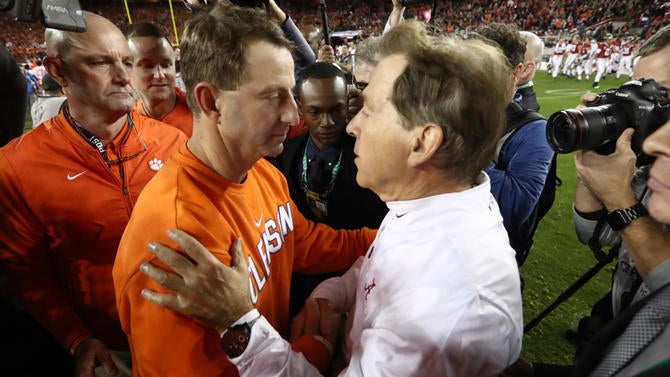
Notre Dame, Army, Oklahoma, Alabama, USC, Miami, Alabama (again). The game has been marked by dynasties. Perhaps no team will ever surpass Oklahoma's 47-game winning streak in the 1950s, but Alabama's five championships since 2009 are probably a close second.
"Keep in mind that everybody got to play at Alabama. Coach Bryant would physically and mentally test you to see how badly you wanted to be on the team. Quite frankly, there were quite a few that didn't," said former Tide running back Major Ogilvie (1977-80), who won two national titles under Bryant.
"Everybody that made the team got to play. Keep in mind, the '79 team, the first five games, our second and third teams played more than the first team."
Big Ten Network anchor Dave Revsine has a unique look into dynasties. In his book, "The Opening Kickoff," he chronicled college football from his birth in 1869 to the early 20th century.
"There were about six or seven years [after Princeton-Rutgers] up until about the 1876 Yale team. That is the first one that said, 'OK, we're not just here to play, We're here to win.' There were seven innocent years."
He continued: "The University of Chicago was the place I would argue more than any school was built on football. … They hired their football coach before they opened the university. They didn't have door knobs on the doors yet, but they had a football coach. They were really big [time]. They, of course, came up with some back door ways of getting people into school."
Chicago dropped football in 1939.
How does it end? Despite all the issues that drag it down, the game just keeps reinventing itself. Faster, younger, newer players. More innovative coaches. Better ways to watch the game.
Saban will be 68 this month and shows no signs of slowing down. Let's hope the likes of Spurrier, retired at 74, never slow down.
"Who's won a Heisman and a national championship? I'm one of those guys. Who else did that, by the way? Oh, nobody?" Spurrier said.
College football at 150?
"It's disturbing, it's great and it's inspiring. And it looks like it will never end," said Roberts.