Five factors that predict who could cap March Madness by winning this season's NCAA Tournament championship
If the NCAA Tournament started today, these two teams look like they could win it all
By
Matt Ward
•
9 min read
As we get set to embark on conference play, the first two months of the college basketball season have been predictable only in the sense of its unpredictability. Whether it be Michigan winning the Battle for Atlantis in convincing fashion, the merry-go-round of teams ranked No. 1 in the AP Top 25 poll, the sudden falter of teams out of the AP Top 25, or teams into AP Top 25, this college basketball season has been full of surprises.
As much as I love the entire college basketball season, but throughout the season, I can't help but think about March Madness. There's just nothing else like it in sports. For that reason, here's a look at who would be cutting the nets down if the NCAA Tournament started today.
I will use a model that is based on a set of five pieces of criteria to predict the winner. I use the AP preseason Top 25 poll, KenPom.com, as well as historical NCAA Tournament data within this model. It is important to know that the KenPom data is based on the rankings at the end of the season for each of the previous 18 national champions. I only looked at the past 18 national champions, as that is as far back as KenPom data goes, beginning in 2002.
Before I get into it, I want to recognize a couple of things. One, these numbers and statistics for the current season are likely to fluctuate daily. As they change, it's possible that the teams that match the designated criteria might change. For now, I am going with through Dec. 31. Two, this information is likely to frustrate some people, while making others extremely happy, and some scratching their heads. I'm sorry if I don't pick your team to win the championship. Don't blame me; blame the data. That said, there are a number of ways to try and predict a champion. This is far from the only one, but it's the one I am going to look at, so here we go.
Over the course of the past 18 years, there have been 11 different schools win the national championship, with UConn winning it three times (2004, 2011 and 2014), UNC winning it three times (2005, 2009 and 2017) Florida winning it twice (2006 and 2007), Duke winning it twice (2010, 2015), and Villanova winning it twice (2016, 2018). Whether it be schools that won it multiple times, one time, first time, or only time, there's a few things that each winner -- or a majority of winners -- had in common.
Here is that criteria and the teams that would be most likely to win the tournament if it started today.
1. Preseason AP Top 25: Only three of the past 18 national champions were not ranked in their respective AP Top 25 preseason poll. That's 83% of the past 18 champions were ranked in the top-25 in the preseason poll. Only Syracuse in 2003, Florida in 2005, and UConn in 2010 were unranked in the preseason and won the national championship -- all three were No. 3 seeds in the NCAA Tournament.
With only three of the previous 18 national champions, dating back to Maryland in 2002, having been unranked in the preseason, I am going with the odds and the statistics here that the national champion in 2020 will come from the Preseason AP Top 25, as has been the case with 83% of the past 18 champions.
2. Adjusted offensive efficiency: Since the existence of KenPom's rankings in 2002, no team has won the national championship that has been ranked lower than 40th in adjusted offensive efficiency. The teams in the preseason AP Top 25 reseason that survived this criteria are:
- Gonzaga
- Michigan State
- Ohio State
- Oregon
- Villanova
- St. Mary's
- Duke
- Louisville
- Arizona
- Kansas
- LSU
- Maryland
- Auburn
- Baylor
- Kentucky
- Utah State
3. Adjusted defensive efficiency: Since the existence of KenPom's rankings in 2002, no team has won the national championship that has been ranked lower than 20th in adjusted defensive efficiency. The teams that survived this criteria from the previous list are:
- Louisville
- Duke
- Kansas
- Ohio State
- Maryland
- Baylor
4. Appearing in the NCAA Tournament the previous season: Of the previous 18 champions, 15 have made it to the NCAA Tournament the previous season. Only three schools, Syracuse in 2003, UConn in 2011, and UConn in 2014, were national champions that missed the tournament the prior season. With the exception of three schools, 83% of the previous 18 national champions made the NCAA Tournament the season prior to their championship season, wiith UConn in 2014 being the last team to win the championship without making the tournament the previous season. The likelihood of this happening again is very small, therefore, any team that is currently on the list that missed the tournament last year was eliminated.
All six teams made the NCAA Tournament last year, therefore none are eliminated.
5. Coach previously appearing in the Final Four: Will this be the coach's first Final Four appearance? Of the past 18 national championship coaches, 15, or 83% had been to the Final Four prior to winning it. Now, some of these are the same coach multiple times like Roy Williams (UNC), Billy Donovan (Florida), Mike Krzyzewski (Duke), Jay Wright (Villanova) and Jim Calhoun (UConn), but 83% is a significant number. Only Bill Self at Kansas in 2008, Kevin Ollie at UConn in 2014 and Tony Bennett at Virginia in 2019, won the national title in their first Final Four appearance.
At least five years has come between first-year final four coaches winning the title. With Bennett winning the title in his first appearance last season, the odds of a coach in his first Final Four winning the championship this year is extremely low--lower than 17% -- therefore, I dropped any school whose coach has not been to a Final Four, eliminating Louisville, Ohio State, Maryland and Baylor.
This leaves two teams left standing after all five tests:
- Duke
- Kansas
Who has the edge: Duke or Kansas?
It probably comes as no surprise to see Duke and Kansas as two teams with a chance to win the championship. It seems as if we can pencil them in for a high seed in the tournament almost every year. It should also come as no surprise that they are the three that came through and passed each of the five criteria.
Teams like Gonzaga, the AP No. 1 team in the country, Michigan State, the AP preseason No. 1 team in the country, and Oregon, a team who has been playing as well as anyone, didn't get past the third criteria in the model used. Duke and Kansas played in Madison Square Garden on the season's opening night, with Duke beating the Jayhawks.
When determining which of these three blue blood programs would cut the nets down if the tournament begin today, I decided to look specifically at KenPom's adjusted offensive and defensive efficiency. What I found was the following:
17 of the past 18 national champions (94%) have been ranked in the top 20 in BOTH offensive and defensive efficiency.
14 of the past 18 national champions (78%) have been ranked in the top 15
10 of the past 18 national champions (56%) have been ranked in the top 10
5 of the past 18 national champions (28%) have been ranked in the top 5
When looking at Duke and Kansas, honestly, you can take your pick. I know Duke has already beaten Kansas on opening night, but honestly, that didn't factor into my decision at all. Both teams are currently ranked in the top-15 in both categories, while Duke is currently the only team in the country ranked in the top-10 in both. Kansas has the 13th ranked offense in the nation and boasts the country's second-best defense, behind only Virginia, while the Blue Devils have the eighth-ranked offense and third-best defense, just behind the Jayhawks.
The numbers between these two teams were extremely tight. The 78% of teams that finished in the top 15 in both offense and defense is a significant number and important one to think about, as both teams would fit into this category. The 56% of teams that were ranked in the top-10 in both offense and defense is a solid number, but wasn't significant enough for me to simply crown Duke as the champs.
In digging a bit further into some other numbers between these two teams, and tendencies of past champions, there are two factors that helped me decide on the team that would win the tournament if it started today: non-conference strength of schedule and freshmen.
While the offensive and defensive efficiency numbers between the two teams are extremely close, with Duke having a slight edge, the strength of each team's non-conference schedule is vastly different. According to KenPom Kansas is 8th, while Duke is 103rd. The average adjusted offensive efficiency of their opponents ranks Kansas as 13th and Duke at 73rd. The biggest difference comes in the average adjusted defensive efficiency of their opponents, as Kansas is 7th, while Duke is 160th. Advantage: Kansas.
The past 18 winners have seen freshmen as the main contributors only three times. Syracuse in 2003, Kentucky in 2012, and Duke in 2015. Duke was the last team to do it, being led by Jahlil Okafor, Justise Winslow, and Tyus Jones, but even they had a senior, Quinn Cook, who was second on the team in scoring that season.
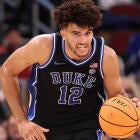
This year's Duke team is once again led by freshmen. Vernon Carey, Cassius Stanley and Matthew Hurt are three of Duke's top-four scorers, with Tre Jones, a sophomore, completing the top-four.
Kansas is far less reliant on freshmen. In fact, Tristan Enaruna and Christian Braun, are the only freshmen that average more than 10 minutes per game. Sophomore Devon Dotson is one of the best guards in the country, and if senior Udoka Azubuike stays healthy, he provides the Jayhawks with a dynamic inside presence, and veteran leadership that is critical in the tournament.
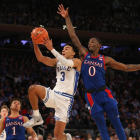
If the tournament started today, the Kansas Jayhawks would be the team to cut the nets down in Atlanta.
Luckily for all other teams, the tournament doesn't start today, but come early March, I look forward to revisiting this model and seeing how things have changed, if at all. For now, let's look forward to enjoying the best of conference play and the best of college basketball.
Just missing the cut
Gonzaga: The AP No. 1 team in the country has looked terrific and will likely head into the tournament in March as the overall No. 1 seed. The Bulldogs are also ranked 1st in offensive efficiency, but it was their 49th ranked defense that doomed them in this model.
Butler: The Bulldogs have looked really good this season as coach LaVall Jordan has them playing at a high level on both ends of the floor. They are currently ranked in the top-20 in both offensive (24th) and defensive (7th) efficiency, but being unranked in the preseason, as well as Jordan not having made a final four yet was too much to overcome in this model.
Oregon: The Ducks are off to a terrific start, thanks to an efficient offense and the play of Payton Pritchard. The 11-2 Ducks have wins over Houston, Memphis, Seton Hall and Michigan. Unfortunately for them, their 63rd ranked defense just simply hasn't been good enough...yet.
Seton Hall: 'm putting the Pirates here, because their 10th ranked defense has been very good. They are currently 55th in offensive efficiency, but have played a number of games without Myles Powell, their best player. Powell can and likely will change that in a hurry, as reports say he could be back for their Big East opener against DePaul.
Others: Louisville, Ohio State, Michigan, Michigan State, Kentucky, and Baylor